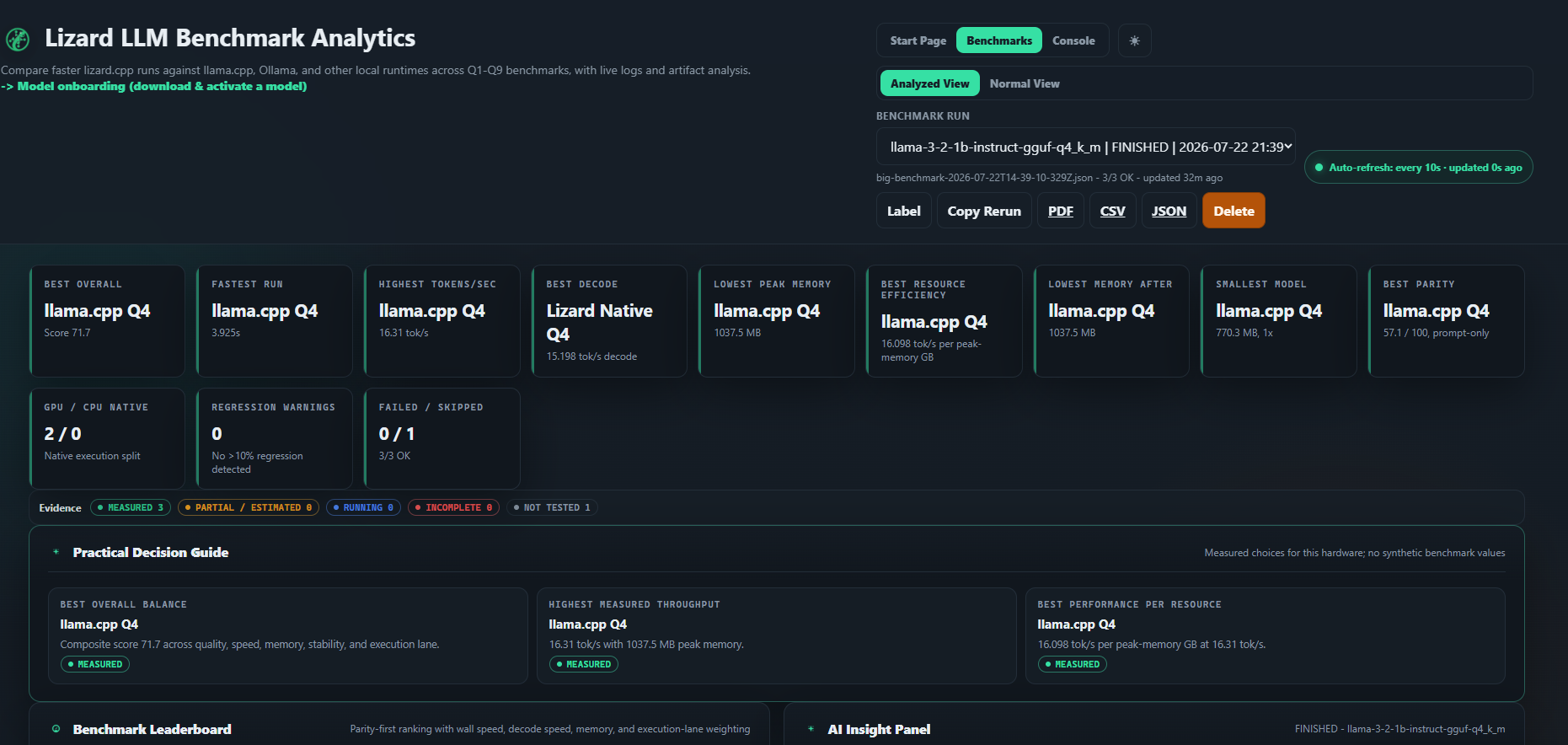
Local LLM benchmarks: Lizard compared with Ollama
Lizard benchmarks local AI runtimes on the user's own Windows PC. The comparison is designed to keep the machine, GGUF model, quantization, prompt, and run conditions consistent so that differences reflect the runtime rather than a different workload. Use the benchmark CLI and HTTP guide to reproduce the measurement with Lizard Native or Caterpillar.
What the benchmark measures
- Prompt-processing and generation speed in tokens per second
- Memory and graphics-memory use
- Successful completion and answer-parity checks
- Warm-up behavior before measured runs
- Results across supported GGUF quantization levels
Why local results matter
Local LLM performance depends on the exact CPU, RAM, GPU, driver, model, and quantization. A result measured on another computer cannot predict every machine. Lizard therefore records results on the hardware that will actually run the model and labels failures rather than replacing them with estimates.
Read the interactive benchmark explanation, inspect the Lizard Native and Caterpillar architecture, explore the runtime and engine design, or run Lizard on Windows.
Real provider-comparison gallery
The interactive page includes 19 new screenshots covering model selection, warm-up, live execution, failures, normal results and analyzed evidence. Lizard Native and Caterpillar remain separate provider lanes beside stock llama.cpp and optional Ollama; excluded providers remain unmeasured rather than appearing as zero.